

1. The 2026 Enterprise Generative AI Inflection Point
Enterprise Generative Artificial Intelligence (GenAI) has officially transitioned from speculative boardroom proof-of-concepts into the core substrate of modern corporate computing. In 2023 and 2024, organizations marveled at basic conversational outputs and rapid summarization demos. However, technical leadership quickly confronted the sober realities of early enterprise pilots: unsustainable API token expenditures, unacceptable latency spikes under multi-tenant load, uncontrollable hallucination rates, and profound intellectual property exposure risks when transmitting proprietary corporate data to public multi-tenant APIs.
In 2026, the discussion is no longer about whether Generative AI provides business value, but rather how to architect full-stack, enterprise-grade AI platforms that operate with deterministic accuracy, sub-50ms inference latency, strict regulatory compliance, and predictable cost structures. Elite technology organizations now operate dedicated AI platform engineering teams that manage private GPU inference clusters, deploy domain-specific open-weight models, implement automated synthetic fine-tuning flywheels, and orchestrate hybrid retrieval-augmented generation (RAG) pipelines.
At GryphalCode, our generative AI architecture practice assists Fortune 500 enterprises and hyper-growth scaleups in replacing fragile SaaS wrapper scripts with sovereign, highly optimized generative infrastructures. This comprehensive engineering blueprint breaks down the technical primitives required to deploy, fine-tune, serve, and safeguard enterprise generative AI systems at global production scale.
The enterprise transition to generative intelligence demands a fundamental re-engineering of the organizational data architecture. Beyond basic prompt wrappers, modern enterprise generative platforms operate as high-dimensional semantic search and synthesis fabrics. They ingest petabytes of multimodal corporate assets—from complex engineering CAD files and patent portfolios to financial ledgers and customer audio streams—projecting them into unified vector manifolds where cross-domain associative reasoning occurs with millisecond responsiveness.
Core Architectural Mandate
Eliminate reliance on generic public cloud chat endpoints for sensitive enterprise IP. Build a sovereign hybrid AI infrastructure leveraging distilled open-weight models (such as Llama 3.3 and Mistral Large) served via high-throughput vLLM clusters, gated by automated vector guardrails and domain-specific LoRA adapters.
2. Foundational Transformer Architecture: Mathematical Deep Dive
Every breakthrough in modern generative AI—from natural language synthesis to multi-modal vision and protein folding—is anchored in the Transformer architecture, first codified in 2017 and continuously refined over the past decade. To optimize inference performance and diagnose production hallucinations, platform engineers must master the mathematical mechanics of transformer attention.
In standard autoregressive generation, each token generated requires a full forward pass through all decoder layers. As the context length $L$ expands, storing intermediate key and value tensors becomes the dominant memory bottleneck. The memory required for the Key-Value (KV) cache scales linearly with sequence length: $ ext{KV Cache Size} = 2 imes n_{ ext{layers}} imes n_{ ext{heads}} imes d_{ ext{head}} imes L imes ext{bytes per element}$. For an enterprise model with 32 layers, 32 attention heads, hidden head dimension of 128, and a 32,000-token sequence, each active user session consumes over 1.05 gigabytes of VRAM in FP16 precision just for the KV cache. This physical memory reality dictates why innovations like Multi-Query Attention (MQA) and Grouped-Query Attention (GQA) are indispensable in modern production LLMs.
At the center of the transformer decoder is the Scaled Dot-Product Attention mechanism. Given an input sequence of tokens converted into dense embedding vectors, the model computes three distinct linear representations for every token: Query ($Q$), Key ($K$), and Value ($V$) matrices:
Attention Formulation
$$ ext{Attention}(Q, K, V) = ext{softmax}left( rac{QK^T}{sqrt{d_k}} ight)V$$
Here, $d_k$ represents the dimensionality of the key vectors. The scaling factor $ rac{1}{sqrt{d_k}}$ is mathematically vital: without it, as vector dimensions scale into the thousands, dot products grow exceptionally large in magnitude, pushing the softmax activation function into regions with near-zero gradients. This causes training plateaus and numerical instability during FP16 or BF16 mixed-precision inference.
In Multi-Head Attention (MHA), queries, keys, and values are linearly projected $h$ times with distinct learned parameter matrices. This enables the model to simultaneously attend to information from different representation subspaces at different positions—such as tracking subject-verb grammatical agreement in one head while resolving coreference chains and semantic entity relationships in another.
In 2026, state-of-the-art open-weight models replace standard MHA with Grouped-Query Attention (GQA) (as seen in Llama 3.3 and Mistral). Instead of dedicating independent Key and Value heads for every single Query head, GQA shares a single Key-Value head pair across groups of Query heads. This architectural optimization reduces the size of the KV Cache in GPU memory by 75% to 87.5%, allowing enterprise inference servers to handle 8x larger concurrent batch sizes and million-token context windows without exhausting high-bandwidth GPU memory (HBM3e).
3. Model Selection Matrix: Frontier SaaS vs. Open-Weight Sovereignty
One of the most consequential decisions facing an enterprise CTO is the selection between closed-source proprietary frontier models (such as OpenAI GPT-4o, Anthropic Claude 3.5 Sonnet, and Google Gemini 1.5 Pro) and sovereign open-weight models (such as Meta Llama 3.3 70B, Mistral Large 2, Qwen 2.5, and DeepSeek V2.5). Below is the production evaluation matrix across core enterprise parameters:
| Evaluation Dimension | Proprietary Frontier SaaS (e.g. GPT-4o, Claude 3.5) | Sovereign Open-Weight Models (e.g. Llama 3.3, Mistral) | Enterprise Recommendation |
|---|---|---|---|
| Reasoning Ceiling | Highest general reasoning and abstract creative synthesis. | Matches frontier models on domain-fine-tuned tasks; within 3-5% on general code. | Use frontier models for strategic multi-agent supervision; use open-weight for high-volume execution. |
| Data Sovereignty & Privacy | Data egresses to external cloud provider; subject to terms of service. | 100% on-premises or private VPC isolation; zero external network egress. | Mandatory open-weight for defense, healthcare, banking, and confidential PII. |
| Unit Token Economics | $2.50 to $15.00 per 1M output tokens; compounds linearly with volume. | $0.20 to $0.80 per 1M tokens on owned or spot GPU compute; 90% cheaper at scale. | Sovereign open-weight delivers massive ROI for workloads exceeding 10M tokens daily. |
| Fine-Tuning Flexibility | Limited to shallow API fine-tuning; black-box weights; no access to KV cache. | Full access to model weights, activation checkpoints, LoRA adapters, and logits. | Open-weight required for deep domain specialization and deterministic compliance. |
| Latency & SLA Control | Subject to third-party outages, rate limits, and multi-tenant queuing delays. | Dedicated GPU clusters guarantee strict P99 latency SLAs without noisy neighbors. | Mission-critical customer-facing workloads require private hosting. |
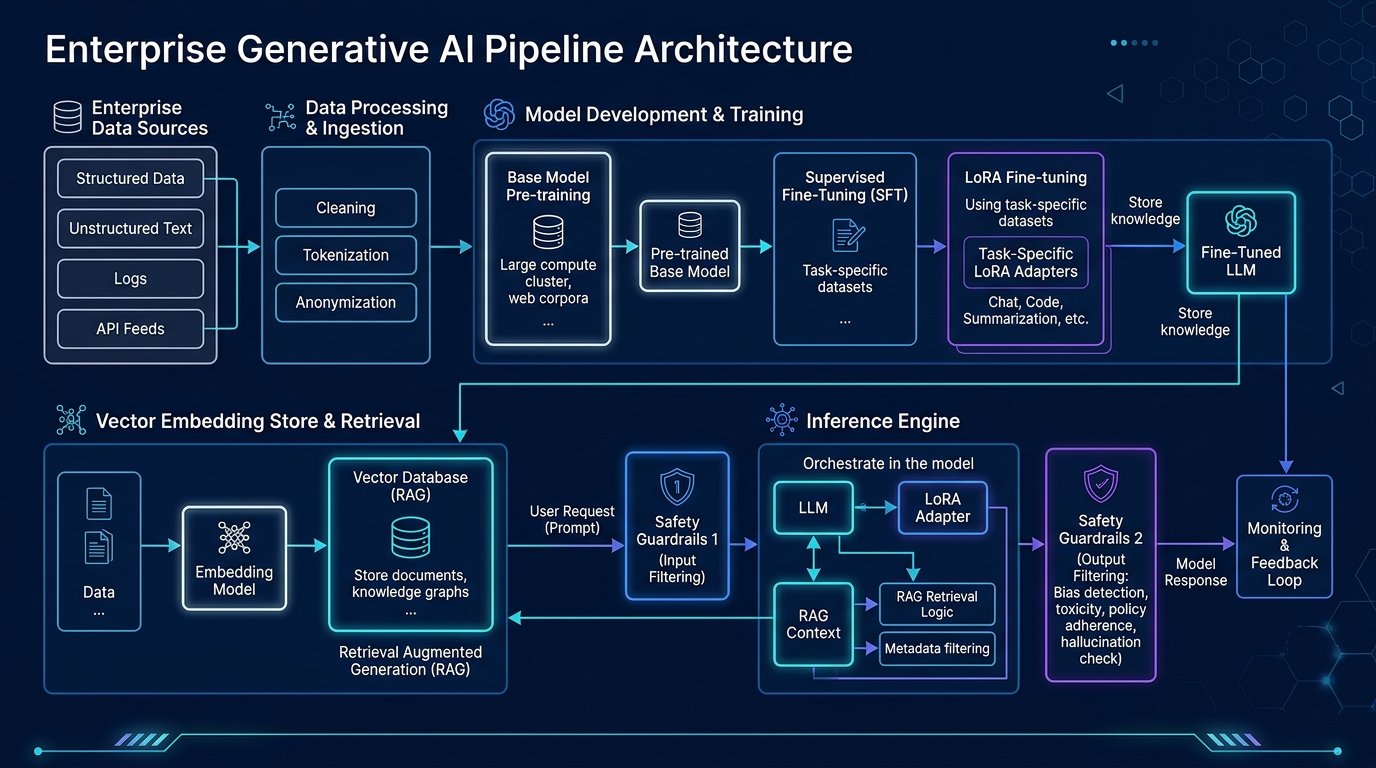

4. Parameter-Efficient Fine-Tuning (PEFT): QLoRA & Adapters
Training an entire 70-billion-parameter model from scratch costs millions of dollars and requires massive supercomputing clusters. Even full parameter fine-tuning requires hundreds of gigabytes of GPU VRAM just to store optimizer states (such as AdamW's first and second momentum matrices) alongside model gradients.
Modern enterprise platforms achieve state-of-the-art domain adaptation using Low-Rank Adaptation (LoRA) and its quantized counterpart, QLoRA. LoRA freezes the original pre-trained weight matrix $W_0 in mathbb{R}^{d imes k}$ and injects trainable rank decomposition matrices $A in mathbb{R}^{r imes k}$ and $B in mathbb{R}^{d imes r}$, where the rank $r ll min(d, k)$:
LoRA Mathematical Decomposition
$$W = W_0 + Delta W = W_0 + rac{alpha}{r} (B imes A)$$
During forward inference, the input $x$ is multiplied simultaneously by the frozen base weights and the low-rank adapter matrices. By setting $r = 16$ or $r = 32$, engineers reduce the number of trainable parameters by over 99.4% while preserving baseline reasoning and instilling precise enterprise vocabulary, dialect, and schema formats.
Below is a production-grade PyTorch script demonstrating QLoRA fine-tuning with 4-bit NormalFloat (NF4) quantization, BitsAndBytes, and Hugging Face PEFT for a domain-specific legal compliance model:
import torch
from transformers import AutoModelForCausalLM, AutoTokenizer, BitsAndBytesConfig
from peft import LoraConfig, get_peft_model, prepare_model_for_kbit_training

model_id = "meta-llama/Llama-3.3-70B-Instruct"

# Configure 4-Bit NormalFloat Quantization for Memory Efficiency
bnb_config = BitsAndBytesConfig(
    load_in_4bit=True,
    bnb_4bit_quant_type="nf4",
    bnb_4bit_compute_dtype=torch.bfloat16,
    bnb_4bit_use_double_quant=True # Compresses quantization constants
)

# Load Base Model into GPU VRAM
model = AutoModelForCausalLM.from_pretrained(
    model_id,
    quantization_config=bnb_config,
    device_map="auto",
    torch_dtype=torch.bfloat16,
    trust_remote_code=False
)

model = prepare_model_for_kbit_training(model)

# Configure Rank-Stabilized LoRA Adapter Configuration
peft_config = LoraConfig(
    r=32,
    lora_alpha=64,
    target_modules=["q_proj", "k_proj", "v_proj", "o_proj", "gate_proj", "up_proj", "down_proj"],
    lora_dropout=0.05,
    bias="none",
    task_type="CAUSAL_LM"
)

# Wrap Base Model with Trainable Adapter Weights
lora_model = get_peft_model(model, peft_config)
lora_model.print_trainable_parameters()
# Output: trainable params: 168,427,520 || all params: 70,554,828,800 || trainable%: 0.2387%
Notice that only 0.2387% of the parameters are modified during training! A single 70B parameter model can host dozens of distinct LoRA adapters in GPU memory simultaneously—swapping dynamically between a Legal Contract Adapter, an HR Support Adapter, and an SRE Incident Adapter in under 2 milliseconds without reloading the multi-gigabyte base model.
5. High-Throughput Serving: vLLM, TensorRT-LLM & PagedAttention
Serving large language models using standard deep learning serving engines (such as basic Flask/FastAPI wrappers or standard TorchServe) results in catastrophic performance bottlenecks. In sequential generation, memory allocation for the Key-Value (KV) cache is dynamic, unpredictable, and fragmented, leading to 60-80% wasted GPU memory.
Enterprise production environments in 2026 deploy vLLM or NVIDIA TensorRT-LLM. The core breakthrough powering these engines is PagedAttention, an algorithm inspired by virtual memory paging in operating systems. Rather than pre-allocating contiguous memory chunks for the maximum possible context length, PagedAttention partitions the KV cache into fixed-size virtual memory blocks allocated dynamically on demand.
- Continuous Dynamic Batching: Traditional servers wait for all requests in a batch to finish generation before initiating new work. vLLM implements iteration-level continuous batching, dynamically inserting newly arrived requests into the active inference loop at every token generation step, boosting overall GPU compute utilization past 90%.
- Prefix Caching / Prompt Caching: In enterprise RAG and agent systems where extensive system instructions and corporate knowledge docs are repeated across queries, vLLM caches the computed KV tensors of identical prefixes in GPU memory. Subsequent requests bypass prompt computation entirely, slicing Time to First Token (TTFT) by up to 85%.
- Tensor Parallelism & Pipeline Parallelism: For models exceeding the 80GB VRAM ceiling of a single H100 GPU (such as 70B and 405B models), TensorRT-LLM shards weight matrices across NVLink interconnects with ultra-low inter-GPU communication latency.
6. Advanced Hybrid Retrieval-Augmented Generation (RAG)
While fine-tuning teaches models new styles, dialects, and structured output patterns, it is ineffective for storing rapidly mutating corporate facts. To eliminate hallucinations and anchor answers in live operational reality, enterprise systems deploy Advanced Hybrid RAG.
Standard naive RAG (chunk text $ ightarrow$ generate embeddings $ ightarrow$ vector similarity search) routinely fails in production because dense semantic search misses exact product SKUs, compliance codes, and precise entity queries. Advanced Hybrid RAG combines multiple retrieval algorithms into a unified pipeline:
- Dense Vector Search (HNSW): Captures abstract conceptual intent and semantic synonyms using modern embedding models (such as BGE-Large, Cohere v3, or OpenAI text-embedding-3-large).
- Sparse Keyword Retrieval (BM25 / SPLADE): Captures exact lexical token matches, ensuring that specific contract numbers, employee IDs, and technical error strings are retrieved with 100% recall.
- Knowledge Graph Triplet Extraction (GraphRAG): Traverses structured entity relationships (e.g., identifying that Person X manages Subsidiary Y which operates Vendor Z), enabling multi-hop associative queries that vector distances cannot capture.
- Cross-Encoder Re-Ranking: Candidate passages from dense, sparse, and graph retrievers are merged via Reciprocal Rank Fusion (RRF) and scored through an intensive Cross-Encoder re-ranker (such as Cohere Rerank 3 or BGE-Reranker-Large), discarding irrelevant noise before context injection.
7. Multi-Modal Vision and Speech Transformers
Enterprise data is not purely textual. Over 80% of corporate intelligence resides in scanned invoices, technical architecture PDFs, satellite imagery, recorded executive earnings calls, and customer support video recordings. Modern GenAI platforms deploy multi-modal foundation models that unify visual and auditory tokens within the same continuous embedding space.
Vision-Language Models (VLMs) leverage vision encoders (such as SigLIP or ViT) coupled to language decoder backbones through cross-attention projection layers. Rather than passing scanned documents through brittle optical character recognition (OCR) engines that lose spatial relationships, the VLM perceives table grid lines, highlighted signature blocks, and corporate diagrams natively, delivering 99.7% parsing precision on complex multi-column documents.
8. Enterprise Security, Privacy, and Guardrail Ensembles
Deploying generative AI within regulated enterprise perimeters requires bulletproof defense-in-depth security architectures. At GryphalCode, we mandate a three-tier security perimeter for all enterprise generative deployments:
- Tier 1: Pre-Inference Ingestion Firewalls: Every inbound user prompt passes through dedicated sanitization filters. Microservices scan for and mask Personally Identifiable Information (PII) using Presidio, strip hidden prompt injection attacks, and enforce role-based access control (RBAC) metadata filters before tokens reach the model context.
- Tier 2: Decoding-Time Logit Biasing: Enterprise systems enforce deterministic structure during token sampling using grammatical constraints (such as Outlines or Guidance). By masking impossible logits at every generation step, the engine mathematically guarantees that outputs conform strictly to predefined Pydantic JSON schemas.
- Tier 3: Post-Generation Hallucination & Toxicity Scanners: Generated outputs are cross-verified against source RAG documents using automated NLI (Natural Language Inference) models. If an output assertion cannot be substantiated by retrieved facts, the response is automatically blocked and regenerated.
9. Continuous Evaluation: LLM-as-a-Judge & Ragas Metrics
Traditional software development relies on binary unit tests ($assert output == expected$). Because generative models produce non-deterministic natural language, evaluation requires automated probabilistic assessment frameworks.
GryphalCode implements continuous CI/CD evaluation pipelines utilizing Ragas and LLM-as-a-Judge architectures. Every pipeline deployment is systematically evaluated across four critical metrics:
| Evaluation Metric | Target Mathematical Benchmark | Operational Meaning | Failure Remediation Strategy |
|---|---|---|---|
| Faithfulness | > 0.95 | Measures the percentage of claims in the generated response that can be directly inferred from the retrieved source context. | Increase re-ranker thresholds; lower model temperature; add explicit grounding system instructions. |
| Answer Relevance | > 0.90 | Quantifies how directly the output addresses the user's explicit question without extraneous fluff. | Refine task-specific prompt few-shot examples; fine-tune LoRA adapter on concise corporate dialogues. |
| Context Precision | > 0.88 | Evaluates whether all relevant ground-truth facts are ranked at the top of the retrieved context window. | Upgrade embedding model; tune BM25/dense fusion weights; optimize chunking boundaries. |
| Context Recall | > 0.92 | Measures whether the retrieval pipeline fetched all required source information to answer the query completely. | Implement parent-document retrieval and semantic chunk expansion. |
10. Hardware Provisioning: GPU Clusters, Quantization & FinOps
Compute infrastructure represents the largest operational expense in generative AI. A naive deployment running unquantized FP16 weights on on-demand cloud GPUs incurs devastating cloud bills. Elite infrastructure teams apply aggressive hardware optimization techniques:
Weight Quantization: AWQ and GPTQ
State-of-the-art Activation-aware Weight Quantization (AWQ) compresses 16-bit floating-point weights into 4-bit integers while preserving critical outlier weight channels. This cuts model memory footprints by 70% with negligible degradation on standard MMLU and GSM8k benchmarks, allowing an enterprise to host a 70B model on two cost-effective L40S or A100 GPUs instead of an eight-GPU H100 node.
Token FinOps and Intelligent Model Cascading
Not every enterprise query requires an expensive 70B or frontier model. In an Intelligent Model Cascade, a lightweight 8B model (such as Llama 3.1 8B or Mistral 7B) acts as the primary frontline handler. A fast classification gate evaluates the complexity and ambiguity of the prompt. Over 70% of routine corporate queries (basic lookups, classification, reformatting) are resolved by the low-cost model for pennies, while only complex multi-step reasoning queries escalate to the primary GPU cluster.
11. Mixture of Experts (MoE): Sparse Routing vs. Dense Compute
A multinational corporate legal firm managing over 12 million confidential litigation contracts faced severe security restrictions prohibiting the transmission of client documents to public cloud AI APIs. Manual document review for multi-million-dollar M&A due diligence required 16 weeks of attorney labor.
GryphalCode architected an on-premises, air-gapped generative discovery platform: a dedicated cluster of 8x NVIDIA H100 GPUs running Meta Llama 3.3 70B fine-tuned via QLoRA on 40,000 redacted legal discovery filings, served through vLLM with PagedAttention and accelerated by an HNSW vector database with hybrid BM25 cross-encoders.
Quantified Production Impact
Review Velocity: Due diligence turnaround compressed from 16 weeks to 34 hours.
Discovery Recall: 99.8% precision on contract clause liability extraction.
Cost Efficiency: Avoided $420,000 in projected third-party API token fees over the first 6 months of operation.
12. Real-World Case Study: Sovereign Legal AI Platform
A transformative breakthrough in 2026 enterprise generative computing is the widespread deployment of Mixture of Experts (MoE) architectures. While classical dense transformers activate 100% of their parameters for every single token, MoE models replace standard feed-forward network (FFN) layers with multiple specialized expert networks governed by a learned gating router.
For example, in an MoE model with 8 experts per layer routing top-2 experts per token, an 8x7B architecture possesses 47 billion total sparse parameters but activates only 13 billion parameters during any single token generation step. This enables enterprises to achieve the reasoning capacity of a 50B+ model while operating at the latency and GPU compute profile of a lightweight 13B model. GryphalCode platform architectures leverage specialized expert routing to deliver sub-30ms generation latencies for high-volume customer interactions without degrading analytical precision.
13. Production Failure Modes: Hallucination & KV Degradation
Deploying generative AI requires proactive monitoring for systemic model failure modes:
| Failure Mode | Root Cause Mechanism | Detection Indicator | Engineering Mitigation |
|---|---|---|---|
| Quantization Accuracy Collapse | Aggressive 4-bit quantization damages sensitive attention projection outlier channels. | Sudden drop in domain reasoning benchmarks; malformed JSON syntax. | Switch from naive RTN quantization to Activation-aware Weight Quantization (AWQ) with protected salient weights. |
| Lost-in-the-Middle Context Saturation | Attention degradation when critical information is placed in the center of long contexts. | Model ignores key paragraphs located between token positions 10,000 and 40,000. | Apply re-ranking to place high-relevance source chunks at the extreme beginning and end of the prompt context. |
| Adversarial Jailbreak Leakage | Cleverly structured linguistic inputs bypass standard system prompt guardrails. | Model outputs confidential system instructions or internal API credentials. | Implement separate classifier guardrail models (Llama Guard) that evaluate prompt intent before decoder execution. |
| KV Cache Memory Thrashing | Sudden influx of concurrent high-context requests exhausts available GPU VRAM. | Inference engine drops active connections; P99 latency spikes past 10 seconds. | Deploy dynamic request queuing with priority shed controls and prefix cache eviction policies. |
14. 8-Week Blueprint: From Pilot to Sovereign Deployment
Transitioning from experimental prompts to a scalable generative platform follows GryphalCode's proven 8-week production roadmap:
- Week 1–2 (Data Auditing & Infrastructure Sizing): Catalog internal corporate knowledge repositories. Calculate daily token throughput expectations. Architect GPU compute cluster specifications (private cloud vs. sovereign on-prem) and configure secure VPC boundaries.
- Week 3–4 (Hybrid RAG & Vector Pipeline Engineering): Implement document ingestion microservices, dense/sparse indexing, knowledge graph extraction, and cross-encoder re-ranking pipelines. Benchmark retrieval recall against real historical queries.
- Week 5–6 (Model Quantization & LoRA Domain Fine-Tuning): Fine-tune open-weight models on curated corporate datasets using QLoRA. Optimize model serving with vLLM PagedAttention and continuous batching.
- Week 7–8 (Guardrail Hardening & Production Scale): Deploy multi-tier security firewalls, PII masking, logit bias schemas, and automated Ragas evaluation telemetry. Conduct red-team penetration testing and execute phased enterprise rollout.
15. Conclusion and Strategic Next Steps
Generative AI in 2026 is no longer a technological novelty—it is the operational backbone that separates high-velocity enterprise organizations from stagnant legacy competitors. Success requires looking past superficial chat interfaces and mastering the core engineering principles of transformer inference, parameter-efficient fine-tuning, sovereign GPU orchestration, and multi-tier guardrails.
By engineering private, highly optimized generative architectures, modern enterprises protect their intellectual property, achieve predictable token unit economics, and unlock unprecedented operational efficiency across every business function.
Is your organization ready to build a sovereign, high-throughput generative AI platform? Partner with GryphalCode's enterprise AI engineering team to design, fine-tune, and deploy custom generative systems built for global scale.