
1. The 2026 Paradigm Shift: From Passive Prompting to Agentic Autonomy
The enterprise artificial intelligence landscape has undergone a monumental architectural transformation. Between 2022 and 2024, corporate adoption focused almost exclusively on conversational interfaces, simple retrieval-augmented generation (RAG) lookups, and single-turn chat prompts. While these initial implementations demonstrated undeniable linguistic fluency, they remained fundamentally passive: an end-user submitted a query, an isolated large language model (LLM) synthesized a probabilistic response, and the interaction abruptly halted.
In 2026, progressive technology leadership recognizes that isolated generative queries cannot resolve intricate business problems. Real-world corporate operations require proactive planning, multi-step environment exploration, dynamic tool execution, contextual memory synthesis, and self-correcting error recovery. This marked the definitive arrival of Agentic AI: computational entities capable of translating abstract high-level strategic objectives into deterministic, multi-hop operational execution cycles without requiring continuous human micro-intervention.
Rather than acting as static text generators, modern enterprise AI agents act as cognitive engines. They evaluate live environmental feedback, consult distributed vector memory banks, invoke enterprise microservices and secure internal APIs, inspect intermediate code outputs, critique their own initial reasoning artifacts, and dynamically recalibrate their execution trajectory until mission verification criteria are satisfied. At GryphalCode, our enterprise AI squad architects high-reliability agentic frameworks that transition corporate IT, financial operations, customer care, and automated DevOps from reactive scripting into resilient, self-governing intelligence meshes.
Strategic Executive Directive
Transition corporate AI roadmaps from static conversational chatbots to goal-driven agentic architectures. Gated by explicit validation state machines and isolated execution perimeters, autonomous agents compress multi-week business operations into seconds while enforcing strict corporate auditability.
2. Core Anatomy of an Enterprise AI Agent: Four Pillar Subsystems
To construct reliable autonomous agents capable of executing within complex regulatory and corporate environments, platform engineers must look past superficial wrapper abstractions and engineer the four fundamental subsystems that govern agentic cognition:
- Cognitive Reasoning & Planning Engine: The central decision core—typically anchored by high-reasoning frontier models such as Claude 3.5 Sonnet, GPT-4o, or Gemini 1.5 Pro. This engine decomposes complex, ambiguous goals into ordered topological sub-task graphs, selects target execution paths, and dynamically creates fallback contingencies.
- Dynamic Tool-Use & Execution Actuators: The set of deterministic interfaces through which the agent interfaces with external reality. This encompasses structured REST/gRPC microservice clients, database query compilers (SQL/NoSQL/Graph), terminal sandboxes, headless browser automation runners, and internal API orchestrators.
- Tiered Contextual Memory Architecture: A multi-layered storage lattice that mimics human cognitive retention: short-term in-context memory buffers, episodic task history (vectorized embedding stores), and persistent semantic/procedural knowledge repositories.
- Self-Correction & Reflection Telemetry: Autonomous validation loops that inspect intermediate execution artifacts, parse runtime compiler logs or API error codes, detect programmatic or semantic hallucinations, and autonomously rewrite instructions prior to downstream propagation.
3. Multi-Agent Orchestration Topologies: Hierarchical vs. Peer Meshes
While single autonomous agents can handle narrowly scoped tasks, enterprise operations demand collaborative multi-agent architectures. In multi-agent systems, specialized agents with distinct domain expertise, distinct system prompts, and distinct tool allowances coordinate to accomplish outcomes beyond the capability of any single monolithic model. In 2026, three primary multi-agent topologies dominate production engineering:
Hierarchical Supervisor Topology
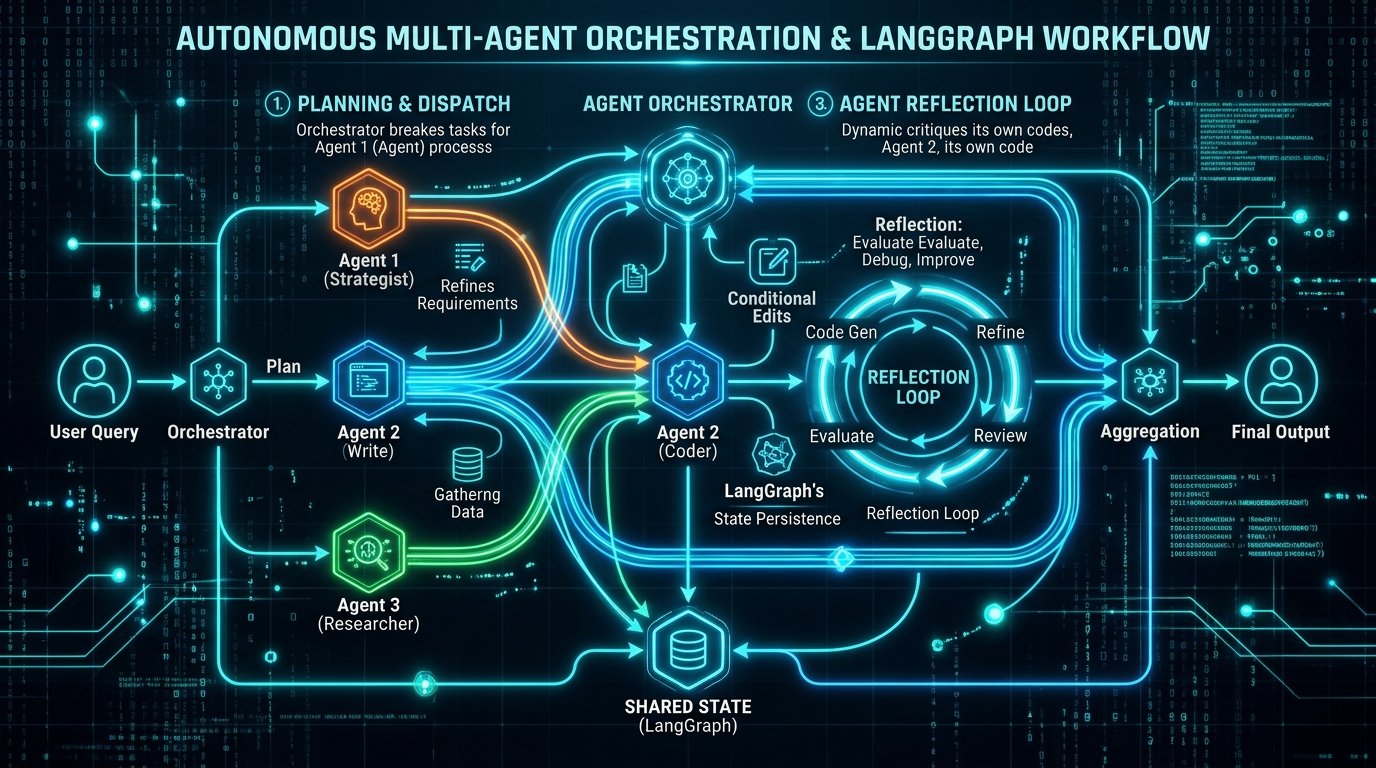
In a hierarchical system, an authoritative Supervisor Agent receives the primary user prompt, constructs a high-level task delegation DAG (Directed Acyclic Graph), and assigns discrete tasks to subordinate Worker Agents (e.g., a Database Extraction Agent, a Code Synthesis Agent, a Compliance Verification Agent, and a Technical Documentation Agent). The supervisor monitors intermediate worker state returns, synthesizes the findings, and triggers re-execution loops if quality thresholds fail.
Peer-to-Peer Collaborative Mesh
In peer-to-peer topologies, autonomous agents interact as specialized equals across a unified message bus or pub/sub event pipeline. For instance, in an automated application security review, a Static Code Analysis Agent detects an SQL injection vulnerability and publishes an alert to the bus; a Patch Generation Agent consumes the alert and generates a remediation PR; an Automated Test Agent executes integration test suites in a container sandbox; and a Security Auditor Agent issues cryptographic SLSA attestations. This model maximizes horizontal throughput and avoids single-point coordinator bottlenecks.
Sequential Pipeline with Verification Interceptors
For strictly audited workflows such as banking transaction approvals or healthcare record transformations, agents execute in a deterministic linear sequence where each transition is gated by a rigorous semantic validation barrier. If an intermediate agent produces malformed data or fails boundary policies, execution halts immediately or routes to a human-in-the-loop escalation dashboard.
4. Deterministic Cycles with LangGraph: Stateful Orchestration
The fatal flaw of early agent experiments (such as AutoGPT or raw LangChain agent executors) was unconstrained non-deterministic looping. Without state persistence, cycles frequently degraded into infinite execution loops, depleting API tokens and generating corrupted outputs. Production systems in 2026 rely on graph-based state machines, spearheaded by LangGraph and custom actor-model orchestrators.
LangGraph models multi-agent workflows as stateful computational graphs where nodes represent agent reasoning steps or tool actions, and edges represent conditional transitions governed by explicit boolean logic and schema assertions. The system state is maintained in an append-only, transactional memory store, allowing execution checkpointing, rollback, and human approval resumption.
from typing import TypedDict, Annotated, List, Union
from langgraph.graph import StateGraph, END
import operator

class AgentState(TypedDict):
    objective: str
    task_plan: List[str]
    code_artifacts: Annotated[List[dict], operator.add]
    test_results: dict
    validation_status: str
    iteration_count: int

def planning_agent(state: AgentState):
    # Generates structured execution steps
    plan = synthesize_strategic_plan(state["objective"])
    return {"task_plan": plan, "iteration_count": state["iteration_count"] + 1}

def execution_agent(state: AgentState):
    # Executes code synthesis using sandboxed tools
    artifacts = execute_code_generation(state["task_plan"])
    return {"code_artifacts": artifacts}

def evaluation_agent(state: AgentState):
    # Inspects execution artifacts against strict unit and compliance tests
    tests = run_sandboxed_test_suite(state["code_artifacts"])
    status = "APPROVED" if tests["success_rate"] >= 0.99 else "REVISE"
    return {"test_results": tests, "validation_status": status}

def routing_condition(state: AgentState):
    if state["validation_status"] == "APPROVED":
        return END
    if state["iteration_count"] >= 5:
        return "human_escalation_node"
    return "execution_agent"

# Build Production State Machine Graph
workflow = StateGraph(AgentState)
workflow.add_node("planning_agent", planning_agent)
workflow.add_node("execution_agent", execution_agent)
workflow.add_node("evaluation_agent", evaluation_agent)
workflow.add_node("human_escalation_node", human_review_fallback)

workflow.set_entry_point("planning_agent")
workflow.add_edge("planning_agent", "execution_agent")
workflow.add_edge("execution_agent", "evaluation_agent")
workflow.add_conditional_edges("evaluation_agent", routing_condition)

app = workflow.compile(checkpointer=PostgresCheckpointer())
This implementation guarantees total operational resilience: the PostgresCheckpointer() persists graph state across process restarts; conditional routing ensures that faulty code cannot escape the evaluation node; and the hard cap on iteration_count prevents financial token leakage by routing stubborn anomalies to human engineers.
5. Dynamic Tool-Calling and Semantic API Dispatch
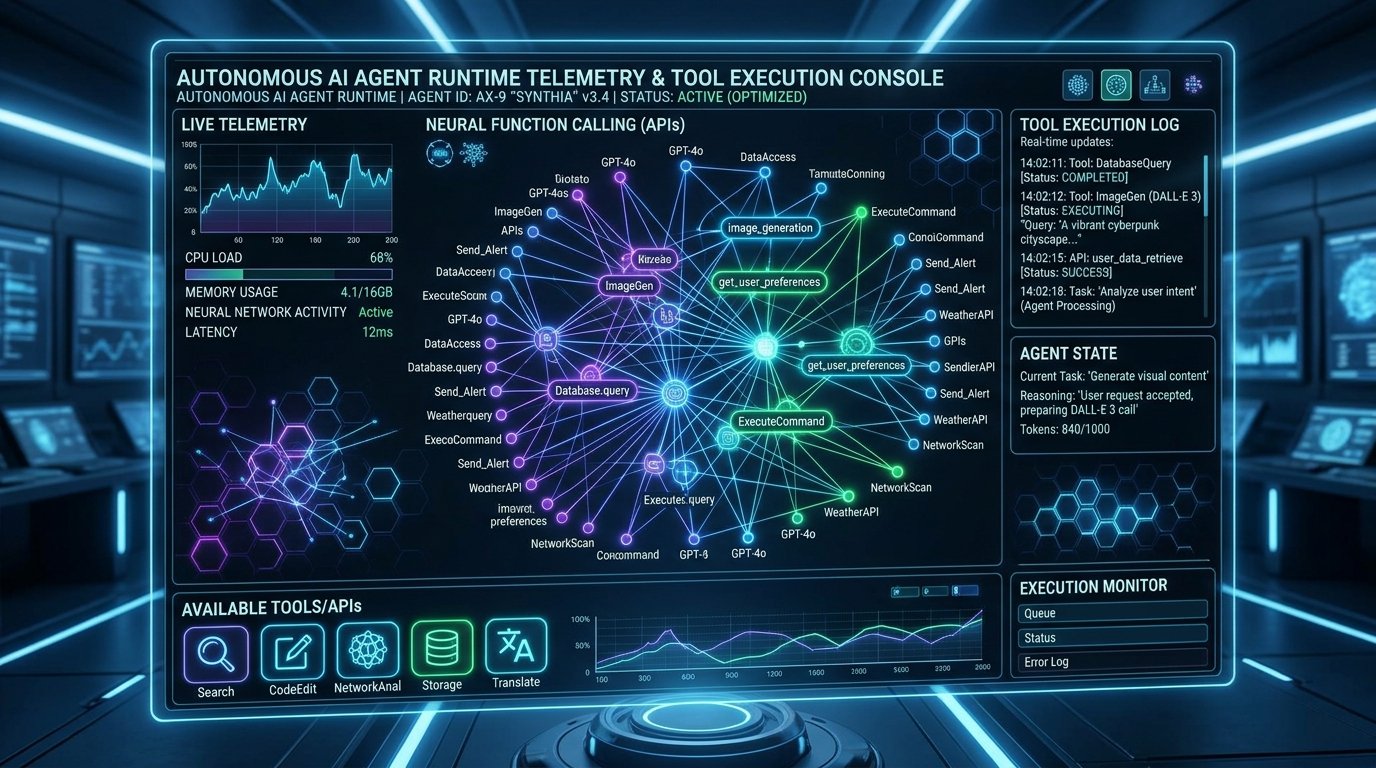
Autonomous agents derive their utility from their ability to enact changes in the real world. In modern architectures, tool calling is not implemented through fragile regex parsing of unstructured model outputs. Instead, agents leverage native function-calling protocols where models emit strictly structured JSON objects validated against JSON Schema definitions.
However, when enterprise environments expose thousands of internal APIs, injecting every tool schema into the model's context window wastes tokens and degrades instruction adherence. In 2026, enterprise platform teams implement Semantic Tool Dispatchers:
- Dynamic Tool Retrieval: Tool definitions are stored within a high-speed vector index (such as Pinecone, Qdrant, or pgvector). When the agent generates a reasoning step, a dense retriever matches the current intent against available tool descriptions, dynamically providing only the top 3-5 relevant schemas to the LLM.
- Deterministic Parameter Guardrails: Every incoming function call argument is intercepted by a Pydantic or Zod validation parser. If an agent attempts to invoke a database deletion tool without a mandatory confirmation token or outside an authorized tenant boundary, the dispatcher rejects the call before execution reaches the database driver.
- Idempotency Token Injection: To protect distributed systems against duplicate side-effects during network retries or agent re-evaluations, dispatchers inject unique cryptographic idempotency keys into all state-altering POST/PUT requests.
6. Advanced Agent Memory Systems: Ephemeral, Episodic, and Procedural
A cognitive agent operating in production cannot rely solely on the prompt context window. Context windows—even when scaling to millions of tokens—suffer from attention degradation, positional latency degradation, and compounding cost overheads. High-performing agent architectures bifurcate memory into three distinct tiers:
| Memory Dimension | Storage Substrate | Retention Horizon | Latency Profile | Primary Operational Role |
|---|---|---|---|---|
| Working / Ephemeral Memory | In-Memory KV / Redis Cache | Current Execution Session | < 5 milliseconds | Maintains scratchpad calculations, active tool outputs, and short-term dialogue state. |
| Episodic Task Memory | Vector Database (HNSW Index) | Weeks to Months | 15 – 35 milliseconds | Indexes past execution trajectories, solved edge cases, and previously resolved debugging traces. |
| Procedural / Semantic Memory | Graph Databases & Relational Schemas | Permanent Corporate Store | 20 – 50 milliseconds | Encodes organization policies, regulatory compliance boundaries, and deterministic runbooks. |
During complex troubleshooting, an agent first consults its procedural memory to identify applicable corporate security policies. It queries episodic memory to recall whether a similar infrastructure anomaly was encountered in another squad last month, extracting the verified resolution plan. Finally, it uses ephemeral memory to hold immediate terminal outputs while synthesizing the patch.
7. Self-Reflection, Critique Loops, and the Reflexion Architecture
In standard zero-shot LLM inference, models exhibit a 15-30% error rate on complex coding and analytical tasks. However, research into the Reflexion Architecture proves that when agents are provided with explicit self-critique cycles, success rates jump to over 90%.
The reflection subsystem operates by bifurcating cognition into an Actor and an Evaluator. The Actor generates an initial candidate solution (e.g., an automated Terraform manifest or an SQL migration script). The Evaluator executes deterministic test suites and security scans against the candidate. If errors arise, the Evaluator generates a structured critique detailing the exact failure line and security vulnerability. The Actor then receives its own previous attempt alongside the critique, iteratively refining the solution until all tests pass.
The 3-Step Reflexion Protocol
Generate: Synthesize candidate solution based on current goal.
Evaluate: Execute programmatic linters, static analyzers, and unit tests in an isolated sandbox.
Refine: Feed specific execution errors back into the reasoning prompt for targeted algorithmic correction.
8. Guardrail Ensembles: Security, Sandboxing, and Blast Radius Containment
The primary barrier to enterprise agent adoption is fear of unconstrained autonomous actions. What happens if an agent misunderstands instructions and deletes a production S3 bucket or exposes customer PII? Enterprise agentic architectures enforce strict Defense-in-Depth Guardrail Ensembles:
Autonomous agents introduce novel attack vectors that classical web application firewalls (WAFs) are blind to. Specifically, Indirect Prompt Injection (IPI) occurs when an agent ingests untrusted third-party data—such as a scraped website, a vendor PDF invoice, or an inbound customer email—that contains embedded adversarial instructions designed to hijack the agent's system prompt. To neutralize IPI threats, production architectures decouple the data extraction plane from the privileged planning plane. Raw external text is first processed by unprivileged, read-only worker models that extract strictly sanitized JSON payloads, ensuring that malicious adversarial strings are neutralized before reaching executive agents.
- Dual-Model Prompt Injection Filters: Inbound user instructions and retrieved third-party web content pass through dedicated, low-latency classifier models (such as Llama Guard or NeMo Guardrails) to intercept indirect prompt injections and jailbreak attempts prior to reaching the core reasoning engine.
- Air-Gapped gVisor / Firecracker Execution Sandboxes: Whenever an agent synthesizes code, queries databases, or runs scripts, execution occurs inside ephemeral, micro-virtualized container runtimes with zero internet egress and strict compute resource ceilings.
- Human-in-the-Loop (HITL) Authorization Gates: State-altering actions with severe impact (e.g., executing financial transfers exceeding $5,000, altering firewall security groups, or dropping database tables) pause the execution graph and trigger an asynchronous webhook notification requiring cryptographically signed manager approval.
- Output Boundary Enforcers: Final artifacts are scanned by automated PII filters, regex secret scanners, and semantic policy validators before delivery to downstream customer applications.
9. Multi-Modal Agent Operations: Vision-Language Actuation
In 2026, autonomous agents are no longer confined to textual terminal environments. Frontier vision-language models (VLMs) enable agents to perceive and interact with graphical user interfaces (GUIs), enterprise desktop applications, complex architectural blueprints, and scanned PDF invoices.
Using semantic grounding coordinates and accessibility tree parsing, vision agents interact with legacy enterprise software that lacks modern REST APIs. The agent inspects visual screenshots of the target enterprise ERP system, calculates precise mouse click coordinates, inputs verified financial values, and validates that visual confirmation dialogs appear. This bridges the gap between modern generative autonomy and decades-old enterprise software infrastructure.
10. Telemetry, Tracing, and Observability with AgentOps and OpenTelemetry
You cannot optimize or secure what you cannot observe. Standard application performance monitoring (APM) tools built for deterministic request-response web apps fail completely in agentic ecosystems where a single prompt triggers dozens of recursive tool calls, reflection steps, and LLM queries.
In high-throughput multi-agent networks, observability requires tracing execution across both synchronous HTTP boundaries and asynchronous message broker topics. When an orchestrator agent delegates a code-review task to a specialist worker agent via an AMQP queue, the OpenTelemetry trace context is injected into message headers. This enables site reliability engineers (SREs) to render complete distributed DAG visualizations showing exact step-by-step latency contributions, token consumption costs, model temperature settings, and tool return payloads across the entire agent collective.
At GryphalCode, we instrument agentic systems with OpenInference and AgentOps distributed tracing standards. Every execution span captures:
- Reasoning Step Call Stacks: Full chronological visualization of every intermediate thought, tool invocation, and decision branch.
- Token Economics & Cost Telemetry: Real-time tracking of input tokens, output tokens, and cache hits across model families, pinpointing cost-inefficient loops.
- Semantic Drift Indicators: Cosine similarity tracking between the original user objective and intermediate agent tasks to detect when an agent begins deviating from its mandate.
- Tool Latency & Error Profiles: P95 and P99 latency tracking for third-party API dependencies, automatically alerting SREs when external tool delays choke agent throughput.
11. Comparative Framework Matrix: LangGraph vs. AutoGen vs. CrewAI
Selecting an agent orchestration framework in 2026 is an architectural decision with multi-year ramifications. The open-source landscape has matured into distinct philosophical approaches:
| Framework | Core Paradigm | State Management | Human-in-the-Loop | Production Readiness |
|---|---|---|---|---|
| LangGraph | Stateful Computation Graph / State Machine | First-class transactional checkpointing (Postgres/Redis) | Native break-and-resume interrupts on any node | Enterprise Grade (Strict schemas, deterministic cyclic flow) |
| AutoGen (Microsoft) | Multi-Agent Conversational Chat | Message-driven conversation history | User proxy input prompts | High Research / Good Enterprise for code synthesis swarms |
| CrewAI | Role-Playing Task Crews (Hierarchical/Sequential) | Task output passing between roles | Manual review callbacks | Rapid Prototyping / Ideal for rapid business logic pipelines |
| Semantic Kernel (Microsoft) | Kernel Plugins and Native SDK integration | Context variable bags | C# and Python native filters | Enterprise Grade (.NET and Azure enterprise workloads) |
At GryphalCode, our production standard for complex mission-critical workflows is LangGraph due to its strict typing, transactional durability, and predictable cyclic edge transitions. For internal development assistants and content synthesis, CrewAI provides unparalleled rapid developer onboarding.
12. Real-World Case Study: Automated Financial Ledger Audit Agent
To demonstrate the quantifiable impact of enterprise agentic architectures, consider GryphalCode's deployment for a multinational fintech client managing over 250,000 daily transaction reconciliations across disparate banking rails:
Prior to agentic deployment, a dedicated team of 24 financial operations analysts manually investigated transaction discrepancies between internal ledger databases, SWIFT messaging feeds, and third-party merchant processor reports. The average turnaround time for resolving a complex ledger anomaly was 4.2 business days, creating substantial regulatory reserve holding liabilities.
We engineered a hierarchical multi-agent audit swarm powered by LangGraph, structured tool-calling microservices, and episodic vector retrieval:
- Ingestion & Triage Agent: Continuously streams transaction error queues, extracts ledger anomaly signatures, and assigns priority scores based on transaction value and regulatory deadlines.
- Forensic Data Mining Agent: Automatically queries SQL ledgers, pulls raw SWIFT MT103 and ISO 20022 wire manifests, and unifies transaction lifecycles into a structured timeline.
- Auditing & Reasoning Agent: Compares wire timeline data against banking fee structures, FX conversion rates, and regulatory compliance rules to identify the exact source of discrepancy.
- Remediation Agent: Formulates journal adjustment entries, verifies accounting equation balance, and submits the adjustment payload to the ERP gateway gated by manager sign-off.
Quantified Business Impact
Turnaround Reduction: Compressed anomaly resolution lifecycle from 4.2 days to 3.8 minutes.
Accuracy: 99.94% deterministic reconciliation accuracy across 1.4 million transactions.
Annual Cost Savings: $1.85 Million in operational personnel reallocation and eliminated overnight liquidity holding charges.
13. Enterprise Governance: ISO 42001 and EU AI Act Compliance
Deploying autonomous decision-making agents introduces direct legal and regulatory compliance mandates. In 2026, global enterprises must align with the ISO/IEC 42001 AI Management System framework and strict EU AI Act Title III regulations governing high-risk autonomous workflows.
Under these regulatory mandates, an agent cannot operate as a black box. Platform teams must establish immutable audit logging capturing: (1) the model weights digest, (2) the exact system prompt version, (3) the retrieved contextual vector chunks, (4) all intermediate tool-calling input and output parameters, and (5) cryptographic digital non-repudiation attestations. GryphalCode integrates automated compliance gates directly into LangGraph state transitions, ensuring that any model action can be forensicly reconstructed and verified during independent compliance audits.
14. Production Failure Modes and Prevention Tactics
Engineering autonomous agents requires deep familiarity with the failure modes unique to probabilistic reasoning loops:
| Failure Mode | Root Cause Mechanism | Operational Manifestation | Architectural Mitigation |
|---|---|---|---|
| Synthesizer Loop Lock | Agent receives a non-descriptive tool error and repeatedly retries the identical payload. | Runaway token consumption, process timeouts, high billing spikes. | Implement exponential backoff, state counter caps, and semantic similarity checks on consecutive tool arguments. |
| Hallucinatory Tool Parameters | Model invents fictitious API parameters not present in the tool specification. | Runtime API failures, corrupted database writes, unhandled exceptions. | Enforce strict Pydantic schema validation at the dispatcher layer with immediate linter feedback to the model. |
| Objective Drift | Over deep multi-step loops, intermediate reflections displace the primary goal from context. | Agent produces technically valid code that solves the wrong business problem. | Anchor the root objective in an immutable system message slot refreshed at every graph step. |
| Cascading Swarm Corruption | Worker Agent A emits flawed assumptions; Worker Agent B builds upon them without verification. | Compounding hallucinations that completely corrupt downstream state. | Introduce independent Critic/Evaluator nodes between all inter-agent message handoffs. |
15. 8-Week Migration Blueprint: Deploying Enterprise Agentic Swarms
Transitioning an enterprise from static software pipelines to autonomous agentic intelligence requires disciplined milestone execution. Below is GryphalCode's proven 8-week production blueprint:
- Week 1–2 (Domain Decomposition & Tool Architecture): Audit candidate operational workflows. Identify repeatable cognitive bottlenecks. Decompose processes into discrete tools with OpenAPI specifications, Pydantic validation schemas, and sandboxed mock environments.
- Week 3–4 (State Machine Modeling & Agent Graph Prototyping): Model multi-agent interaction topologies in LangGraph. Define immutable system states, entry conditions, and routing assertions. Implement basic working memory in Redis and episodic persistence in PostgreSQL.
- Week 5–6 (Guardrail Enforcement & Sandbox Isolation): Deploy air-gapped code execution containers. Implement input/output prompt injection filters and cryptographic human-in-the-loop authorization gates for state-altering transactions.
- Week 7–8 (Full Observability & Phased Production Cutover): Instrument OpenInference distributed tracing and AgentOps telemetry dashboards. Run shadow execution trials alongside human teams. Transition 10% of live traffic with statistical drift alarms, scaling to 100% upon verification.
16. Conclusion and Strategic Next Steps
In 2026, the competitive divide in enterprise technology is no longer defined by who has access to foundational LLMs—these models have become accessible commodities. The decisive advantage belongs to organizations that master Agentic Architecture: the ability to bind cognitive models to deterministic state machines, reliable tool dispatchers, persistent multi-tier memory systems, and rigorous guardrails.
By transforming passive conversational models into autonomous, self-healing execution agents, modern enterprises compress multi-day operational workflows into instantaneous automated convergence loops. Whether in financial auditing, autonomous cybersecurity, automated software engineering, or intelligent supply chain routing, agentic systems represent the defining architecture of enterprise scalability.
Ready to deploy high-reliability autonomous agents across your enterprise software stack? Partner with GryphalCode's senior AI and systems architects to design, benchmark, and deploy enterprise-grade agentic swarms that drive measurable operational ROI.