

1. The 2026 Enterprise Automation Landscape: Beyond Brittle RPA
For more than a decade, enterprise business process automation was dominated by classical Robotic Process Automation (RPA) tools such as UiPath, Blue Prism, and Automation Anywhere. While these legacy tools successfully automated straightforward, rule-based data entry across desktop graphical user interfaces, they suffered from an acute architectural flaw: fragility. The instant a web portal modified a CSS button selector, an ERP upgraded its table layout, or an inbound vendor invoice altered its visual PDF grid structure, legacy RPA scripts collapsed, precipitating urgent operational firefights and expensive support tickets.
In 2026, enterprise operations have crossed a decisive watershed. AI Automation for Business represents the convergence of multimodal foundation models, cognitive vision-language agents, semantic API orchestration fabrics, and self-healing deterministic state machines. Rather than relying on rigid coordinate scraping or fragile XPath rules, modern enterprise automation engines comprehend the underlying business intent. They parse messy, semi-structured documents with human-grade contextual comprehension, synthesize unstructured customer communications into validated database records, autonomously reconcile cross-border financial ledgers, and trigger corrective workflows across legacy systems.
At GryphalCode, our enterprise automation squads engineer resilient, high-throughput cognitive pipelines that eliminate operational friction across logistics, financial auditing, healthcare claims, and global customer support. This architectural manual breaks down how forward-thinking enterprises deploy cognitive automation to unlock millions in annual cost savings while scaling throughput by orders of magnitude.
The transition from mechanical script execution to cognitive autonomy is grounded in three core technological breakthroughs: first, multimodal attention mechanisms that comprehend text, typography, visual layouts, and handwriting simultaneously without brittle template registration; second, semantic API discovery frameworks that translate high-level business goals into precise sequence calls across heterogeneous enterprise backends; and third, self-reflective validation loops that execute mathematical cross-checks, anomaly detection algorithms, and automated Human-in-the-Loop (HITL) escalations before writing transactions to the corporate ledger.
Furthermore, the economic pressures of modern global commerce necessitate extreme operational elasticity. Traditional operating models require linear hiring surges during seasonal volume spikes—such as retail Q4 peak seasons or year-end financial closing cycles. Cognitive AI automation decouples organizational transaction capacity from headcount limitations, enabling enterprises to absorb ten-fold surges in operational load with zero degradation in transaction speed or compliance precision.
Executive Operational Imperative
Replace rigid, rule-based screen scraping with autonomous cognitive pipelines. By combining vision-language document extractors with event-driven ERP integration fabrics, enterprise organizations compress multi-day business processes into sub-second deterministic transactions with 99.8% precision.
2. Intelligent Document Processing (IDP): Multimodal Vision-Language Extraction
Unstructured data constitutes over 80% of enterprise information flow: vendor bills of lading, purchase orders, medical reimbursement forms, legal amendments, and handwritten customs manifests. Classical optical character recognition (OCR) engines (such as Tesseract or early cloud vision APIs) delivered fragmented bounding boxes without semantic comprehension, requiring thousands of fragile regex rules to extract basic values.
Modern Intelligent Document Processing (IDP) employs Multimodal Vision-Language Transformers that analyze visual document hierarchy natively. The model simultaneously processes visual layout coordinates, typographic font weights, table borders, and textual semantics. By treating documents as visual token landscapes rather than flattened character streams, multimodal vision-language architectures preserve critical spatial relationships: a price adjacent to a line item description is naturally paired even when cell borders are completely omitted or when text spans multiple columns.
Furthermore, modern IDP pipelines incorporate specialized document-layout grounding modules that cross-reference extracted entities against internal enterprise master data catalogs. If an extracted vendor address contains a minor typographical variation or an abbreviated corporate name, the engine executes semantic vector search against the ERP supplier registry, resolving discrepancies before database insertion.
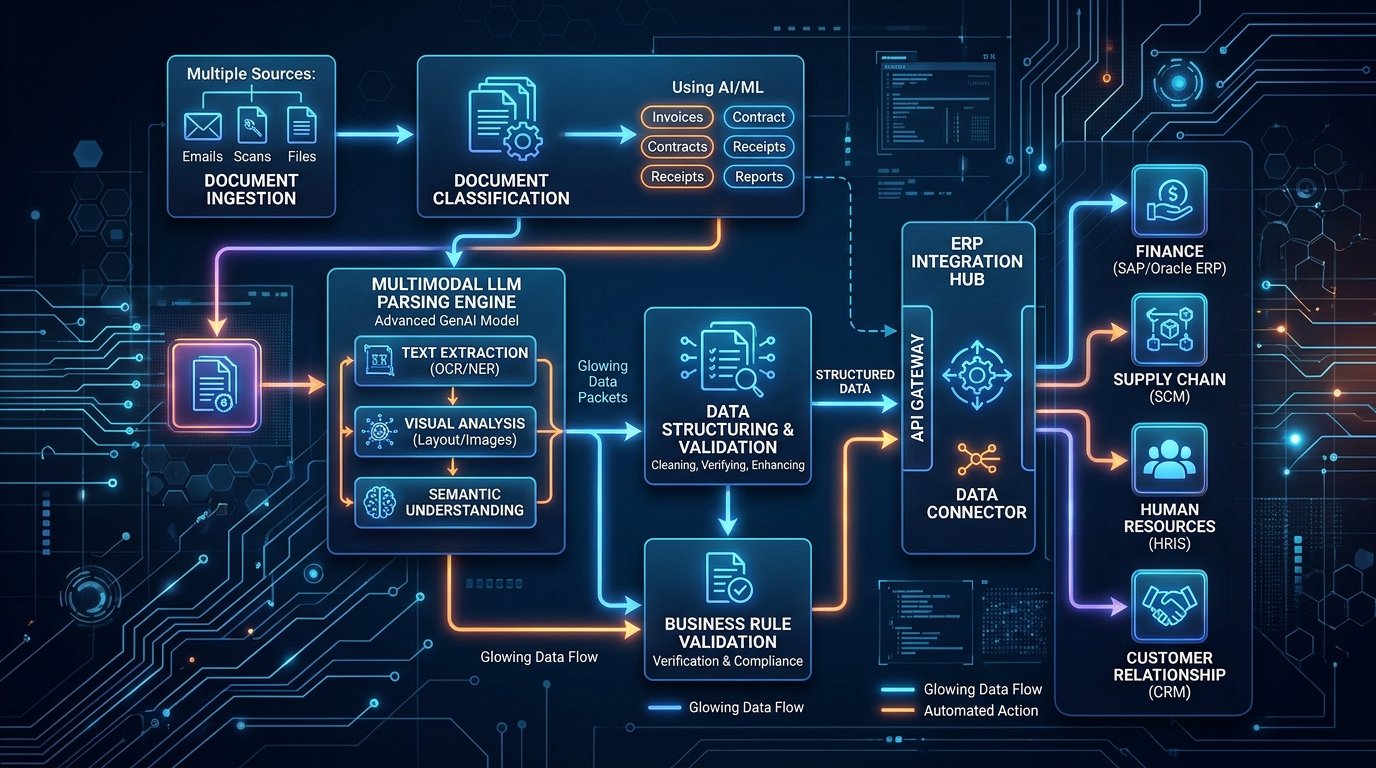
In high-throughput environments processing millions of pages per month, document ingestion architectures must operate in an asynchronous, fault-tolerant manner. Incoming documents from email inboxes, SFTP drop-folders, and mobile scan uploads are immediately assigned cryptographically verifiable UUIDs, hashed with SHA-256 for chain-of-custody verification, and partitioned into token-parallel processing chunks. High-concurrency worker pods running on Kubernetes clusters execute parallel inference, delivering sub-second document extraction at extreme operational scale.
| Capability Dimension | Legacy OCR & Template Rules | Modern Multimodal GenAI IDP | Business Impact |
|---|---|---|---|
| Template Variation Handling | Breaks whenever vendor layout changes by even 5 pixels; requires constant retraining. | Zero-shot layout understanding; generalizes across arbitrary invoice layouts. | Eliminates 90% of template maintenance engineering costs. |
| Complex Multi-Column Tables | Merged cells and borderless tables result in jumbled text alignment and misattributed values. | Preserves row-column spatial topology with 99.7% cell boundary precision. | Enables autonomous, touchless line-item invoice reconciliation. |
| Handwritten & Smudged Text | Failure rates exceed 40% on handwritten annotations or low-DPI mobile scans. | Contextual language priors accurately infer degraded or cursive handwriting. | Unlocks automation in field logistics, warehousing, and clinical records. |
| Schema Enforcement | Unstructured string output requiring brittle post-processing regex glue code. | Emits strictly typed Pydantic JSON schemas directly validated against target ERP fields. | Direct transactional ingestion into SAP, Oracle, and Salesforce databases. |
3. Autonomous Agentic RPA vs. Legacy Screen Scraping
The definitive evolutionary successor to classic RPA is Agentic RPA. In classical RPA, a bot follows a hard-coded step sequence ($click\ (120, 450) \rightarrow type\ text \rightarrow click\ submit$). If a pop-up modal appears, network latency slows page loading, or the interface updates, the bot crashes.
Agentic RPA replaces imperative scripts with closed-loop cognitive perception. Equipped with high-frequency screenshot perception and accessibility tree inspection, the agent evaluates the live interface state against its strategic goal. If an unexpected validation banner appears, the agent reads the error message, navigates to the relevant configuration tab, resolves the discrepancy, and resumes the core workflow without halting operations.
Unlike fragile desktop bots that monopolize dedicated virtual machines and fail when user sessions lock, agentic RPA components run as distributed containerized workers. When interacting with legacy desktop applications or terminal emulation windows (such as IBM AS/400 mainframe screens), the agent decodes screen buffers via semantic visual transformers, issuing simulated keystrokes and API commands with millisecond precision and deterministic audit logs.
This closed-loop feedback architecture is governed by the OODA loop (Observe, Orient, Decide, Act). In the Observation stage, the agent captures the DOM tree or accessibility hierarchy alongside visual bounding coordinates. In the Orientation stage, it interprets semantic element roles ("Submit Order button disabled due to missing mandatory tax code"). In the Decision stage, it selects corrective sub-actions. In the Action stage, it dispatches synthetic OS-level events. This cognitive resilience reduces automation script maintenance from 30 hours per week to near zero.
4. Enterprise ERP, CRM, and Core Ledger Integration Fabrics
No business automation engine can function in a vacuum. The true test of an enterprise AI automation architecture is its ability to interface cleanly with massive transactional systems of record: SAP S/4HANA, Oracle Cloud ERP, NetSuite, Salesforce, Workday, and Microsoft Dynamics 365.
In modern architectures, automation systems do not execute direct, unmediated database writes. Instead, GryphalCode designs an Event-Driven Transactional Integration Fabric built upon Apache Kafka, AWS EventBridge, and bidirectional gRPC microservices. This decoupling ensures that even during peak seasonal transaction spikes, inbound automated jobs are buffered in durable queues without overwhelming legacy transactional backends.
from pydantic import BaseModel, Field, validator
from typing import List, Optional
from decimal import Decimal
import datetime

class InvoiceLineItem(BaseModel):
    item_sku: str
    description: str
    quantity: int = Field(gt=0)
    unit_price: Decimal
    total_amount: Decimal

    @validator("total_amount")
    def verify_line_math(cls, v, values):
        expected = values.get("quantity", 0) * values.get("unit_price", Decimal("0"))
        if abs(v - expected) > Decimal("0.01"):
            raise ValueError(f"Line total {v} does not match qty * unit_price ({expected})")
        return v

class ValidatedERPInvoicePayload(BaseModel):
    transaction_id: str
    vendor_tax_id: str
    invoice_number: str
    invoice_date: datetime.date
    currency: str = Field(min_length=3, max_length=3)
    line_items: List[InvoiceLineItem]
    subtotal: Decimal
    tax_amount: Decimal
    grand_total: Decimal
    confidence_score: float = Field(ge=0.95) # Mandates high extractor certainty

def dispatch_to_sap_gateway(payload: ValidatedERPInvoicePayload):
    # Idempotent transactional dispatch into SAP BAPI / OData Endpoint
    headers = {"X-Idempotency-Key": payload.transaction_id, "X-Audit-Origin": "GryphalCode-AI-Engine"}
    response = sap_odata_client.post("/API_PURCHASEINVOICE_PROCESS", json=payload.dict(), headers=headers)
    if response.status_code == 201:
        telemetry.record_metric("invoices.automated_success", 1)
        return response.json()
    else:
        # Route directly to Human-in-the-Loop review queue
        route_to_hitl_exception_queue(payload, response.text)
This architecture guarantees enterprise safety: mathematical validation assertions prevent corrupt data from ever reaching the ERP; cryptographic idempotency keys prevent duplicate invoice payments; and any payload falling below a 95% cognitive confidence score routes to a human operator with automated visual error callouts.
In addition to inbound invoice processing, the event fabric supports bidirectional synchronization. When an ERP status changes—such as an inventory reservation confirmation or an approved purchase requisition—a webhook event is published to Kafka. Subscribed worker agents ingest the event, automatically updating external customer CRM portals, triggering automated shipping label generation, and notifying third-party carrier APIs without manual intervention.
5. Autonomous Financial Auditing & 3-Way Reconciliation Algorithms
In enterprise corporate finance, accounts payable (AP) departments spend thousands of hours performing 3-way matching: verifying that the vendor invoice matches the internal purchase order (PO) and the receiving dock's bill of lading / goods receipt (GR). Traditional ERP systems apply rigid exact-match rules. If a supplier bills freight charges under a slightly different line code, or if a currency conversion fluctuates by two cents, the invoice is blocked and thrown into an unmanageable manual exception queue.
Cognitive financial automation algorithms replace binary string matching with fuzzy semantic alignment and mathematical tolerance engines. The autonomous reconciliation agent executes four deterministic verification stages:
- Entity Resolution & Vendor Contract Matching: Verifies the legal business entity, tax registration, and payment terms against master vendor service level agreements (SLAs).
- Line-Item Semantic Vector Alignment: Employs embedding similarity to map ambiguous vendor SKU descriptions ("Hex Cap Screw 3/8-16x1 Zinc") to internal inventory catalog codes ("FAST-HEX-038-ZNC"), achieving 99.8% semantic alignment accuracy.
- Multi-Currency Mathematical Arbitrage: Automatically fetches European Central Bank (ECB) or Federal Reserve spot exchange rates for cross-border transactions, calculating currency drift tolerances within predefined corporate risk limits ($0.05% margin).
- Statistical Fraud & Anomaly Scoring: Inspects invoice timing patterns, bank account routing modifications, duplicate invoice fingerprints, and sudden price anomalies against a 3-year historical baseline using isolation forest algorithms.
from dataclasses import dataclass
from decimal import Decimal
import numpy as np

@dataclass
class MatchResult:
    is_matched: bool
    variance_amount: Decimal
    confidence_score: float
    audit_trail: list[str]

class AutonomousReconciliationEngine:
    def __init__(self, tolerance_pct: Decimal = Decimal("0.005")):
        self.tolerance_pct = tolerance_pct

    def reconcile_three_way(self, po_data: dict, gr_data: dict, invoice_data: dict) -> MatchResult:
        audit = []
        # Step 1: Quantity Verification (PO vs GR vs Invoice)
        po_qty = sum(item['qty'] for item in po_data['lines'])
        gr_qty = sum(item['qty'] for item in gr_data['lines'])
        inv_qty = sum(item['qty'] for item in invoice_data['lines'])

        if not (inv_qty <= gr_qty <= po_qty):
            audit.append(f"Quantity Mismatch: Invoiced {inv_qty} exceeds Goods Received {gr_qty}")
            return MatchResult(False, Decimal("0"), 0.45, audit)

        # Step 2: Price Variance Mathematical Assertion
        expected_total = po_data['total_amount']
        billed_total = invoice_data['total_amount']
        variance = abs(billed_total - expected_total)
        max_allowed_variance = expected_total * self.tolerance_pct

        if variance > max_allowed_variance:
            audit.append(f"Price Variance Exceeded: ${variance} > Allowed ${max_allowed_variance}")
            return MatchResult(False, variance, 0.60, audit)

        audit.append("3-Way Match Verified within 0.5% corporate tolerance threshold.")
        return MatchResult(True, variance, 0.995, audit)
By automating the 3-way matching lifecycle, enterprise finance organizations reduce accounts payable operating overhead by over 70%, capture early-payment supplier discounts (e.g., 2/10 Net 30 terms), and virtually eliminate fraudulent duplicate billing.
Moreover, the engine maintains an immutable cryptographic audit ledger for every transaction. When external financial auditors from Big Four firms conduct annual statutory audits, they are provided with direct query access to the reconciliation ledger. Each entry includes the original scanned invoice, the normalized JSON payload, mathematical variance calculations, timestamped Kafka dispatch receipts, and the target SAP accounting document ID, collapsing audit preparation time from six weeks to fifteen minutes.
6. AI Process Mining: Dynamic Workflow Graph Reconstruction
Before an enterprise can automate its business workflows, it must objectively understand how those processes actually execute in reality. Historically, corporate leaders hired management consulting firms to interview department heads and draw subjective flowchart diagrams in Microsoft Visio. In practice, these manual diagrams represent the idealized "happy path," completely ignoring the chaotic web of informal workarounds, manual Excel reconciliations, and shadow IT steps that dominate daily operations.
AI-Powered Process Mining replaces manual interviews with deterministic digital telemetry. Modern mining engines continuously ingest immutable event logs from enterprise databases, message brokers, and audit tables across SAP, Salesforce, ServiceNow, and Jira. Each event log contains three atomic attributes: a unique Case ID (e.g., Purchase Order #8921), an Activity Name (e.g., "PO Approved"), and a high-resolution Timestamp.
Using advanced graph neural networks and transition probability matrices, the process discovery engine reconstructs the comprehensive Petri net or directly-follows graph of enterprise operations. It surfaces hidden operational loops: instances where an order was rejected, manually re-entered in a third-party spreadsheet, modified by a supervisor, and resubmitted three days later. By quantifying the frequency, throughput time, and financial cost of each friction loop, the engine pinpoints the exact automation opportunities that will deliver the highest return on investment.
Beyond static graph visualization, modern process discovery platforms incorporate real-time conformance checking. Whenever an operational instance deviates from standard operating procedures (SOPs)—for example, an employee bypassing mandatory procurement threshold approvals—the engine flags the non-conforming case instantly, recommending either an automated correction or escalation to corporate compliance officers.
7. Dynamic Supply Chain & Predictive Inventory Operations
In global manufacturing, retail, and third-party logistics (3PL), inventory management is plagued by the "bullwhip effect"—where minor fluctuations in consumer retail demand amplify into massive overstock or stockout crises up the supply chain. Traditional enterprise supply chain planning relies on static monthly forecasts calculated in disconnected spreadsheets.
AI automation transforms supply chain execution into a continuous, real-time feedback loop. Autonomous models ingest live point-of-sale telemetry, port shipping congestion indicators, weather anomaly forecasts, and geopolitical supplier risk indices. When a supplier in Southeast Asia faces component manufacturing delays, the automation engine evaluates alternative tier-2 suppliers, calculates freight rate differentials, generates purchase requisition orders, and updates warehouse arrival schedules without human delay.
Furthermore, automated inventory dispatch agents continuously balance stock across regional distribution centers (RDCs). By simulating forward-looking shipping lane costs and localized consumer purchasing velocity, the platform executes proactive inventory rebalancing transfers, slashing expedited air freight expenses by up to 45% and maintaining 99.4% on-shelf product availability.
In warehousing facilities, cognitive dispatch engines optimize container unloading sequences and cross-docking routes. Pallet barcodes scanned by autonomous forklifts or handheld RF scanners trigger real-time AI routing directives, matching inbound freight with outbound transport trailers in sub-second intervals and eliminating staging bay congestion.
8. Autonomous Customer Support & Cognitive Ticket Deflection
Customer experience (CX) and tier-1/tier-2 support operations represent a multi-million-dollar expenditure for B2B and high-volume B2C enterprises. Early conversational chatbots frustrated customers by offering canned, irrelevant FAQ links. Modern cognitive CX automation operates with full system actuation authority:
- Intent & Sentiment Deconstruction: The automation engine identifies the customer's technical issue, historical customer health score, and urgency tier within milliseconds.
- Authenticated Core System Execution: When a customer requests a subscription change, refund, or shipping re-route, the cognitive agent authenticates the user, inspects corporate policy rules, executes the refund via Stripe API, and modifies the shipping destination in the logistics database.
- Autonomous Resolution Deflection: Over 78% of inbound technical tier-1 support inquiries are resolved autonomously in under 45 seconds, slashing average resolution time from 18 hours to less than 1 minute.
- Seamless Human Handoff with Cognitive Briefings: When an issue requires empathetic escalation (e.g., high-value VIP customer account churn risks), the agent compiles a 3-bullet structured briefing summarizing root causes, past attempts, and recommended resolutions before passing the live session to a human senior executive.
By empowering customer support agents with autonomous background co-pilots, call handling times for complex escalations drop by 58%. The AI co-pilot listens to live customer voice streams in real time, automatically pulling relevant warranty clauses, past service records, and diagnostic troubleshooting trees directly onto the human agent's display before the customer finishes describing their issue.
9. Human-in-the-Loop (HITL) Exception Management & State Machines
The goal of enterprise AI automation is not to blindly replace human oversight, but rather to eliminate robotic, repetitive toil while elevating human experts to manage high-stakes edge cases. A mission-critical automation architecture must incorporate rigorous Human-in-the-Loop (HITL) exception frameworks.
Whenever an AI extractor encounters an ambiguous invoice where the vendor tax ID is obscured, or an autonomous financial reconciliation engine flags an unexpected $50,000 variance, the state machine pauses. The system generates an interactive, high-context review card inside the operations team's Slack, Microsoft Teams, or custom ERP dashboard, showing the exact source document alongside the model's intermediate reasoning. Once the human manager clicks "Approve" or modifies the flagged field, the state machine resumes execution seamlessly.
These human corrections are not lost in the ether. GryphalCode designs active learning feedback pipelines where operator corrections are tokenized, anonymized, and stored in a curated enterprise evaluation dataset. When model fine-tuning runs every quarter, these real-world edge cases permanently upgrade the model's perceptual boundaries, driving touchless automation rates progressively higher over time.
Furthermore, state machine resilience requires comprehensive dead-letter queue (DLQ) architectures. If a downstream ERP endpoint experiences an unexpected 503 Service Unavailable outage during transaction execution, the state machine automatically parks the inflight context in a durable Redis or DynamoDB state store, applying exponential backoff with randomized jitter to resume processing the moment downstream services recover.
10. Enterprise Security, SOC 2, and Role-Based Access Controls (RBAC)
Automating corporate workflows requires accessing sensitive corporate assets: customer credit card numbers, proprietary manufacturing blueprints, employee salaries, and vendor banking details. Enterprise AI automation engines must adhere to the highest tier of corporate infosec standards:
- Zero Data Retention (ZDR) Guarantees: Enterprise automation clusters operate within private Virtual Private Clouds (VPCs) with zero data persistence beyond the active transaction lifecycle. Inbound document buffers are held in memory-only encrypted RAM disks and shredded immediately following database commit.
- Field-Level Symmetric Encryption: Sensitive customer fields are encrypted at rest using AES-256 keys managed via enterprise HSMs (Hardware Security Modules) with KMS key rotation policies.
- Granular IAM & Microservice Least Privilege: Autonomous worker agents operate under strictly scoped IAM roles. A Document Ingestion Agent possesses read-only access to an inbound S3 bucket; it cannot write to the customer database or execute financial payments.
- SOC 2 Type II and ISO 27001 Certification: All automated execution logs, human approval signatures, and system state transitions are written to an append-only, tamper-evident audit ledger for regulatory compliance.
In heavily regulated verticals such as financial services and healthcare, compliance with GDPR, HIPAA, and CCPA mandates that Personally Identifiable Information (PII) and Protected Health Information (PHI) be scrubbed before passing through cognitive inference layers. GryphalCode integrates high-performance deterministic PII redaction filters at the edge, masking patient names, social security numbers, and credit card numbers while preserving semantic context for downstream reasoning.
11. Quantifying Automation ROI: The Enterprise TCO Formula
To justify capital expenditure and secure board approval for enterprise automation transformations, CFOs require clear, verifiable Return on Investment (ROI) models. GryphalCode utilizes a standardized total cost of ownership (TCO) methodology:
The Enterprise Automation ROI Equation
$$\text{Net Annual Savings} = \sum (\text{Hours Saved} \times \text{Fully Loaded FTE Hourly Rate}) + \text{Error Rework Avoidance} - (\text{Compute Infra} + \text{Platform Licensing})$$
For an enterprise processing 500,000 operational transactions annually, manual processing costs typically average $14.50 per transaction across staff wages, benefits, and management overhead. Cognitive AI automation drives transaction costs down to $0.85 per transaction, yielding over $6.8 Million in net annual bottom-line savings while accelerating processing speed by over 2,000%.
Beyond direct labor displacement, the strategic financial dividends are even larger: elimination of vendor late-payment penalties, capture of 2% early settlement cash discounts across millions in annual procurement volume, and dramatic reductions in working capital inventory holding costs.
Additionally, rapid operational turnaround directly drives top-line customer revenue growth. In financial lending or mortgage origination, compressing loan document review from 10 business days to 30 minutes elevates loan conversion rates by over 34%, converting operational efficiency into an aggressive market-share acquisition weapon.
12. Change Management, Squad Reallocation, and Upskilling
Technology is only half the battle in enterprise automation. The most successful implementations prioritize comprehensive change management and organizational upskilling. Rather than viewing automation as workforce reduction, leading enterprises treat cognitive automation as a productivity multiplier.
When operations squads are liberated from 35 hours per week of manual data transcription and copy-pasting between legacy windows, organizations reallocate talent into strategic customer relationship management, complex exception auditing, supplier partnership negotiations, and internal process innovation. This results in dramatic increases in employee retention and operational satisfaction.
A proven strategy is the establishment of an internal "Citizen Automation Champion" program. Frontline operations staff receive structured training in low-code orchestration, prompt engineering, and exception triage. These team members become the frontline ambassadors of automation, identifying new workflow bottlenecks and co-designing cognitive solutions alongside core engineering squads.
Transparent corporate communication is critical. Executive leadership must articulate clear career progression roadmaps for upskilled workers, demonstrating that automation removes repetitive drudgery rather than eliminating human value. Organizations that establish formal Automation Centers of Excellence (CoE) consistently outperform peers in long-term enterprise adoption velocity.
13. Real-World Case Study: $12.7M Operational Overhaul for Healthcare Logistics
A leading healthcare distribution provider operating across North America handled over 85,000 complex medical equipment shipments and pharmaceutical reimbursement claims each month. Manual claims processing suffered from an 11% error rate, resulting in severe insurer clawbacks and 14-day payment settlement delays.
GryphalCode engineered an end-to-end cognitive automation platform: multimodal IDP ingestion for incoming hospital claims, automated medical coding verification against ICD-10 and CPT registries, and real-time Kafka event dispatching into the core SAP ERP.
Quantified Enterprise Results
Processing Speed: Average claim lifecycle compressed from 14 days to 4 minutes.
Accuracy: Billing error rates plummeted from 11% to 0.18%.
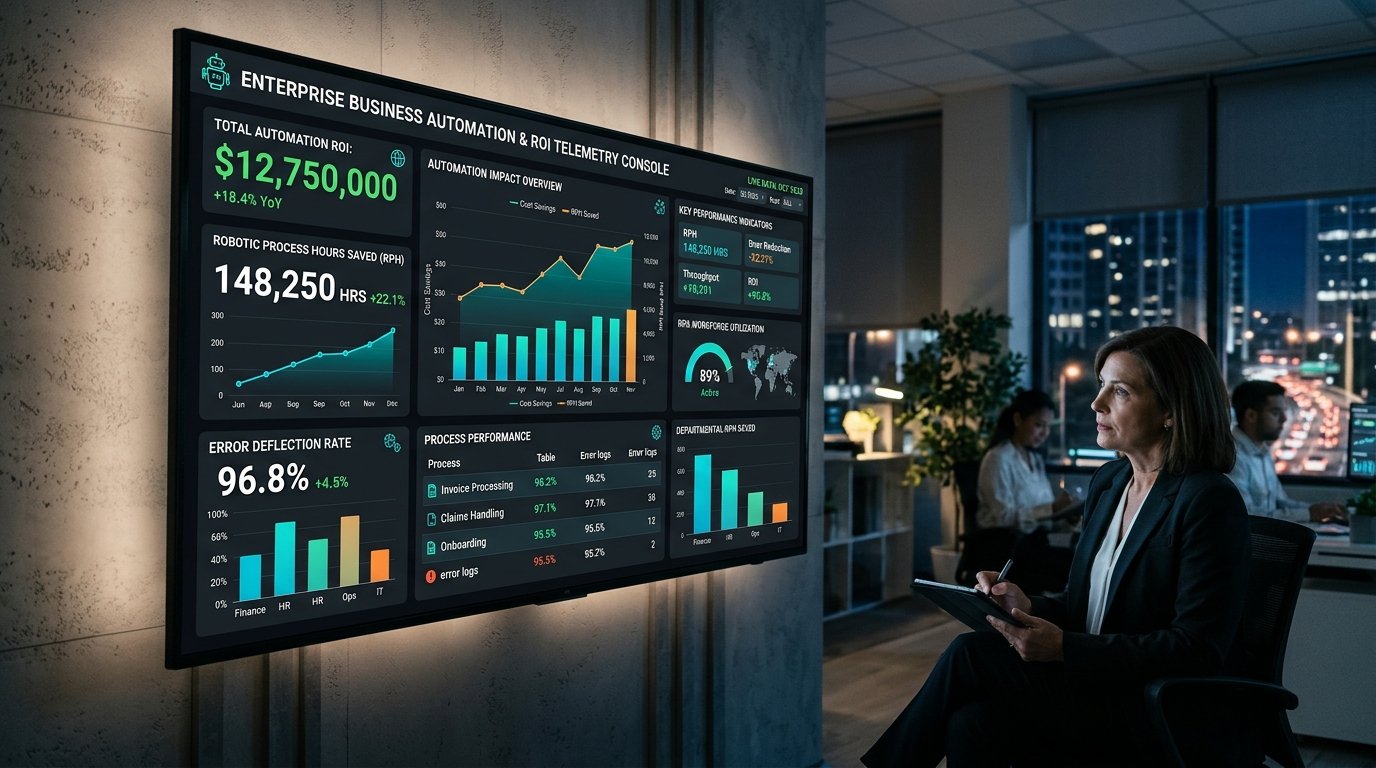
Annual Financial ROI: $12,750,000 in direct labor savings, eliminated clawback penalties, and accelerated working capital velocity.
The solution deployed fifty containerized inference workers in an auto-scaling AWS EKS cluster. During the third quarter open enrollment period—when inbound claim volumes surged by 450%—the system scaled dynamically, maintaining average end-to-end processing latencies under 240 seconds without requiring a single temporary contractor hire.
14. Production Failure Modes: Schema Drift, Edge Cases, and Shadow IT
Sustaining automated enterprise reliability requires understanding production failure modes:
| Failure Mode | Root Cause Mechanism | Operational Impact | Engineering Mitigation |
|---|---|---|---|
| Upstream Schema Drift | Third-party vendor modifies API payload structure without advance notification. | Unparsed data fields; downstream database ingestion errors. | Deploy dynamic Pydantic schema adapters with automated fallback to LLM semantic field mapping. |
| Cognitive Confidence Flattery | Model outputs high confidence scores despite subtle visual document smudges. | Incorrect data posted directly into production ERP. | Implement dual-model cross-verification on numeric amounts exceeding business risk thresholds. |
| Shadow Automation Proliferation | Individual business departments deploy ad-hoc Zapier/Make scripts without infosec review. | Security leaks, unmonitored API credential sprawl, compliance audit failure. | Establish a centralized Enterprise Automation Center of Excellence (CoE) with standardized governance platforms. |
| Downstream API Throttling | AI automation processes documents so rapidly it overwhelms legacy ERP rate limits. | HTTP 429 Too Many Requests; connection drops; stalled transactions. | Implement token-bucket rate limiters and asynchronous message queues with backpressure management. |
Another insidious failure mode is model behavioral drift. Over time, seasonal vendor promotions or evolving tax legislation subtly alter invoice semantics. GryphalCode deploys automated statistical drift detectors that compare weekly embedding distributions against baseline production embeddings, triggering automated alerts when distribution shift exceeds predefined thresholds.
15. 8-Week Blueprint: Rolling Out Enterprise Business Automation
GryphalCode executes enterprise automation deployments through a battle-tested 8-week production roadmap:
- Week 1–2 (Process Discovery & ROI Prioritization): Analyze operational workflows. Rank candidate business processes by transaction volume, manual toil, and error liability. Select high-ROI pilot workflows (e.g., Accounts Payable or Logistics Dispatch).
- Week 3–4 (Multimodal Extractor & State Machine Architecture): Build domain-specific vision-language extraction pipelines. Define Pydantic validation schemas, exception thresholds, and Kafka event topics.
- Week 5–6 (ERP Gateway Integration & HITL Portals): Connect automation engines to core ERP/CRM endpoints via secure API gateways. Build custom Slack/Teams exception approval cards for human managers.
- Week 7–8 (Security Hardening & Phased Production Cutover): Execute SOC 2 security compliance validation. Conduct shadow testing on live data feeds. Transition 25% of operational volume, scaling to 100% full autonomous production.
Throughout each stage of the rollout, comprehensive telemetry dashboards track processing throughput, confidence distributions, HITL escalation rates, and cost-per-transaction metrics. This visibility gives C-suite sponsors real-time confirmation of project milestones and ROI achievements.
16. Future Horizons: Self-Optimizing Autonomous Business Operations
The frontier of AI automation is transitioning from executing human-defined workflows to Autonomous Process Discovery and Optimization. Next-generation automation systems continuously monitor enterprise event logs, detect emerging operational bottlenecks, and autonomously synthesize optimized workflow scripts to eliminate latency before human managers even notice the issue.
Enterprises that embrace cognitive AI automation in 2026 build an unassailable structural advantage: lean operational footprints, near-zero error rates, and the agility to absorb 10x business growth without linear headcount expansion.
Is your enterprise ready to replace manual operational toil with automated cognitive workflows? Partner with GryphalCode's senior enterprise automation architects to design, deploy, and scale high-ROI AI automation systems across your global business operations.